dreamex.ai
AI merch platform — generate, customize, order
An AI-driven merch platform concept developed for a gaming audience. Combining generative visuals, customization, and e-commerce into a single streamlined experience.
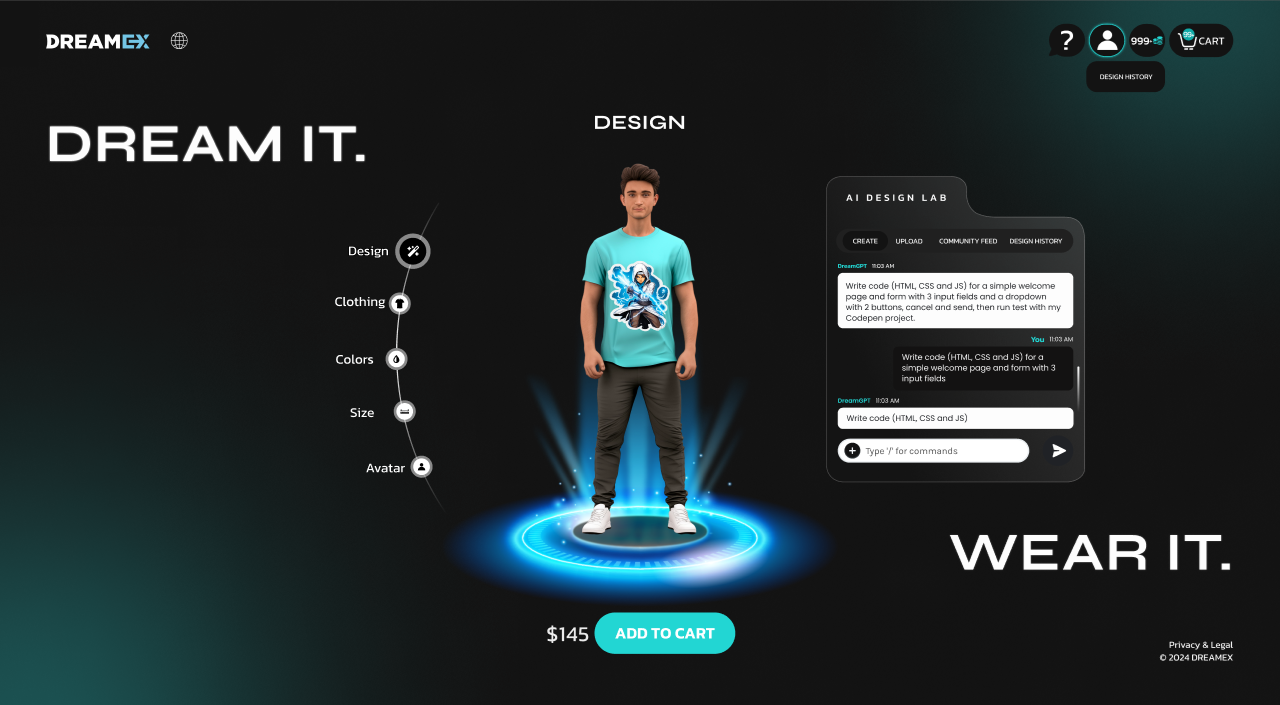
Generate a design with AI. Place it on a product. Preview in 3D. No design skills required.
A professional gamer with a community and a vision.
dreamex.ai was initiated by a well-known professional gamer aiming to explore early AI-driven product opportunities for their community. The goal was to create a webshop where users could generate and purchase custom-designed merchandise based on AI-generated visuals.
from concept to platform
Given the complexity of the concept, a custom native application was initially considered. However, due to budget constraints and the uncertainty of launching a new product, the project shifted towards a web-based solution — a pragmatic decision that allowed faster iteration without compromising on quality.
Scope definition
Multiple planning phases mapped every user flow — from registration through prompt submission to final order — before a single line of code was written. Each feature had clear acceptance criteria and technical boundaries.
Budget-conscious
The shift from native app to web-based platform was deliberate. It preserved the full feature set while cutting projected development cost significantly and reducing time to first demo.
Specialist team
External experts in AI integration and 3D development were engaged alongside the core team. Clear role boundaries and shared documentation kept progress smooth across disciplines.
Full-flow ownership
The platform was designed to handle everything — from image generation to product customization and order processing — while remaining accessible and cost-efficient to operate.
the full flow
Every step from prompt to parcel lived inside one browser-based experience. No app installs, no context switching — consistent on desktop and mobile.
T-shirts & sweatshirts
The webshop supported multiple product types, starting with t-shirts and sweatshirts. Users could select base colours and sizes, and choose from 3D-modelled avatars tailored to a gaming audience.
Each avatar was designed specifically for the project — proportions and rendering optimised for real-time browser performance. The product catalogue was structured to expand as the platform scaled.
Prompt & browse
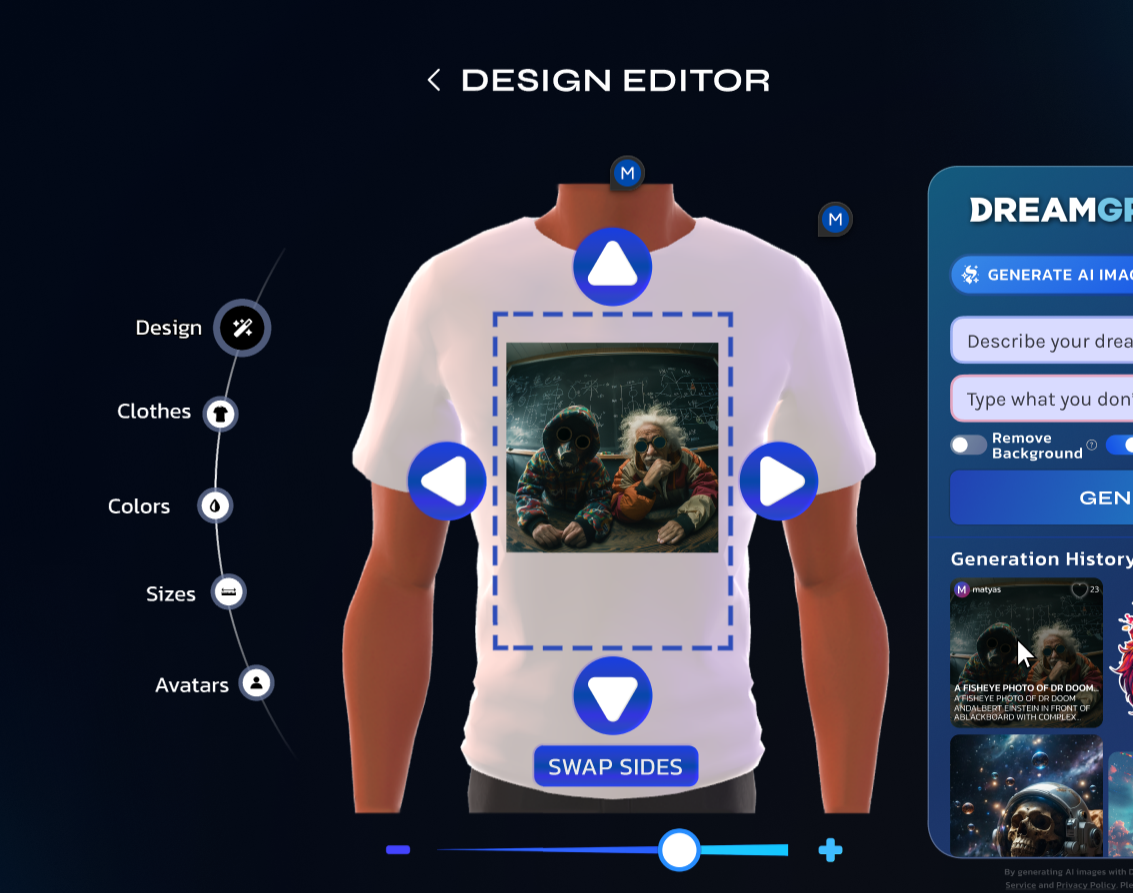
After registration, users could submit prompts within defined limits. AI-generated images via Midjourney returned multiple variations per prompt, with the option to browse previously generated results from their account history.
Prompt limits kept generation costs predictable. The browsable history meant users could revisit earlier results without re-generating — reducing both cost and wait time while encouraging experimentation.
Design on 3D model
Selected designs could be positioned directly onto 3D models, allowing users to preview their product before purchase. Rotation, scale, and placement were adjustable in the browser. Drafts were saved to user accounts for later use.
The 3D rendering was executed entirely client-side, with optimized file sizes and load times tailored to each product. Ensuring consistent performance across lower-powered mobile devices was one of the most technically demanding aspect of the project.
Payment to production
Orders included payment processing, invoicing, and automated preparation of print-ready assets. Final designs and order data were transferred to production partners, who handled manufacturing, delivery timelines, and fulfilment.
The handoff was fully automated — no manual export or file preparation. Order data, print files, and customer details flowed directly to partners on payment confirmation.
midjourney in the loop
The AI component was implemented efficiently, building on prior experience within the team. Users submit a text prompt, Midjourney generates visual variations, and the results are returned to the user's account — ready to preview on a product.
The integration handled queuing, result polling, image storage, and rate limiting per account. Prompt constraints were defined collaboratively with the client during the specification phase, balancing creative freedom with operational cost control.
Avatars
3D-modelled avatars were developed specifically for dreamex — each representing a gaming archetype, rendered in real-time in the browser.
The 3D system required the most extensive customization of any component. Adapting models for consistent performance, handling texture mapping at various resolutions, and delivering reliable results across devices from desktop to mid-range mobile — this was where the specialist collaboration proved most valuable.
preparation & execution
The project involved multiple planning phases to define scope and technical requirements. Careful specification upfront prevented costly pivots later — every integration point, user flow, and edge case was documented before development began.
Phased planning
Requirements were gathered across several workshops. Each phase produced documented specifications covering user flows, API contracts, and performance targets. By the time development started, the team had a clear, shared understanding of every component.
Cross-team coordination
External AI integration and 3D development specialists worked alongside the core team. Shared tooling, regular syncs, and well-defined handoff points kept collaboration smooth — no blockers, no surprises, no wasted cycles.
The level of preparation on dreamex reflected a shared commitment to getting it right. Every user flow — from first prompt to production handoff — was specified, reviewed, and agreed upon before development began. Edge cases were anticipated, integration contracts were locked, and testing criteria were defined per component. The result was a smooth, browser-based experience functioning consistently on both desktop and mobile — delivered without scope creep, without rework, and with a clear line from plan to product.
Thorough specification
Careful scoping and documented requirements meant every team — core, AI, 3D — worked from the same blueprint. No ambiguity, no wasted effort.
Expert collaboration
Bringing in external specialists for AI and 3D while the core team owned architecture and integration. Clear ownership, clean interfaces between components.
End-to-end platform
Prompt to production in one session. AI generation, 3D preview, payment, and automated handoff — no separate tools, no manual steps.
Responsible handover
When the client chose a different path, the project was handed over with complete assets, documentation, and knowledge transfer. Professional closure on both sides.
Fully functional.
Cleanly delivered.
The project reached a fully functional demo stage. At that point, the client decided to continue development within a Shopify-based environment with another team. The project was formally handed over, including all relevant assets and knowledge transfer, concluding the collaboration with a mutually positive outcome.
The cooperation throughout reflected a high standard of professionalism on both sides — clear communication, respected timelines, and a shared understanding that good work deserves a clean conclusion regardless of where the product goes next.
have an idea?
let's make it work.
Send us a message and we'll get back to you quickly.